A bit of marketing before the summer break: nothing too technical today, just a small curiosity I wanted to share before heading into August. You’ve probably heard of shrinkflation. But have you noticed how it always follows the same silent rule: never cross a round price point? Here’s the theory of nine, or how a single digit became an entire industry’s quiet weapon.
Downsizing, or the art of never crossing the threshold
Since the 2022-2023 inflation peak (+5.2% then +4.9% in France according to Insee), brands have faced a dilemma: costs are rising, but the displayed price is sacred. The solution? Don’t touch the price. Shrink the quantity instead. Carrefour’s CEO, Alexandre Bompard, put it bluntly about Magnum ice cream: “it dropped by 200 milliliters and the price went up 20%. That’s shrinkflation.” This is where the theory of nine kicks in: a price displayed at €2.99 or €4.99 becomes a mental anchor. Crossing it would create a disproportionate perception shock. Shrinking the content, on the other hand, goes almost unnoticed.
Psychological pricing, or why your brain loves the number 9
The science behind this has a name: the left-digit effect, demonstrated in the landmark study by Thomas & Morwitz. We read prices left to right. The result: €2.99 is perceived as much closer to €2 than to €3, even though the actual gap is one cent. A Berkeley study goes further: the average consumer treats a .99 price as if it were 15 to 20% cheaper than its real value.
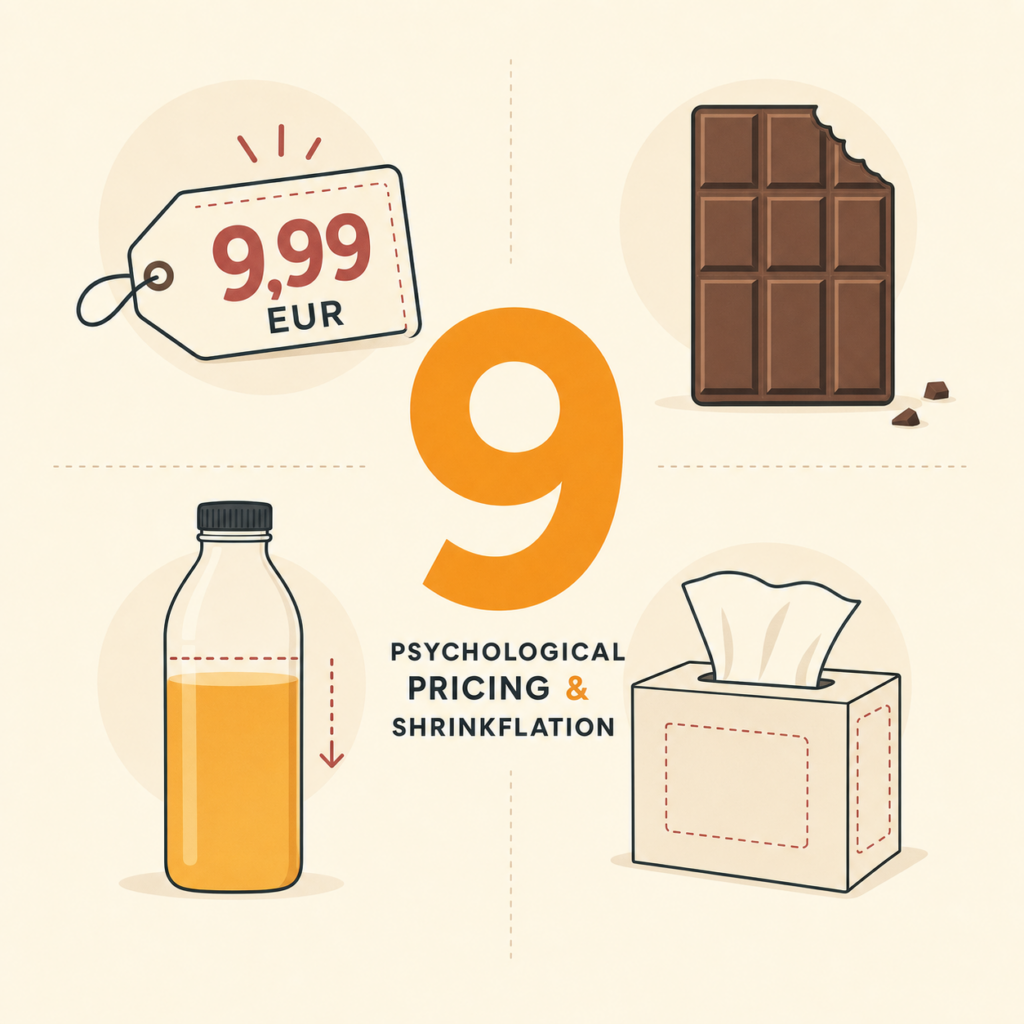
Two brands illustrate two different uses of the same principle:
Decathlon applies it head-on and systematically: €9.99, €24.99, all the way up to €459.99 on premium gear. Here, the 9 is a brand signature, consistent with a “sport accessible to everyone” positioning. Zara plays it more subtly: according to a recent e-commerce pricing analysis, 75% of its prices end in .95 rather than .99. The same cognitive mechanism applies, but .95 feels slightly more “honest” — better suited to an accessible-premium fashion image than a .99 too closely tied to pure discount retail.
In other words: the theory of nine isn’t monolithic. Every brand calibrates its “just-below-round” number to match the image it wants to project. True luxury brands, by contrast, avoid .99 pricing entirely — a round number signals exclusivity, not a bargain.
Innocent and the mystery of the missing liter
Ever looked for a full liter of Innocent juice on the shelf? You won’t find one. The brand sells its juices in 90cl (900ml) bottles, not a full liter. Le Monde documented this back in 2018, explicitly citing Innocent as an example of this strategy, framed “with a view to price competition”. One caveat worth being precise about: no source confirms a specific goal of “staying under €3” but the result is still there, eight years later, still 90cl.
The invisible tissue box
Here, the theory of nine is so deeply embedded it’s become invisible. Look for a box of facial tissues in any supermarket: you’ll find nine. Always nine. Carrefour, Kleenex, store brands, Lotus — they all sell boxes of 9 tissues. The 10-tissue format vanished from the market so long ago that nobody even asks for it anymore. This might be the most telling example of all: the reduction has become the norm, to the point where we no longer even remember there was a “before.”
KitKat, when nine becomes a design reflex
And finally, the most revealing example. Nestlé publicly confirmed in 2024 that it had reduced its “fun size” mini KitKats from 17 to 14 grams (-17%), citing surging cocoa and sugar costs. But there’s an even stronger case. In October 2025, Nestlé launched an entirely new KitKat tablet range (Hazelnut, Double Chocolate, Salted Caramel). Their weight? 99 grams. Not 100. Straight from launch, there was never a 100g version of this product to begin with. The number 9 is no longer a fallback trick in response to inflation. It has become a design reflex, baked in natively from a product’s very first day.
And what about the law?
Since July 1, 2024, French regulation requires retailers with stores larger than 400 m² to clearly disclose any shrinkflation, with fines of up to €15,000. A field survey by consumer group UFC-Que Choisir in July 2024, covering 423 stores, found that 95% of them displayed… nothing at all. The law exists. The number 9 just keeps quietly doing its thing.
So next time you see a price ending in 9, ask yourself: what was quietly taken away to make it fit?
Happy summer break, everyone.