I wanted to start this new year by revisiting a fascinating topic that I had the opportunity to explore and manage during my time at Teledyne e2v, before leaving the company in 2019 to launch BNB markets.
As the OCT market manager, I gained a deep understanding of the industry’s requirements, customer expectations, and the many challenges involved in integrating an OCT camera into complex biomedical systems.
For this new year, I’ve chosen a theme that takes me back to that exciting period at Teledyne, marked by extensive travel across Europe, the United States, China, and Japan during the product introduction phase. I’d also like to acknowledge Paul Danini, who defined the camera specifications with remarkable precision, thanks to his deep understanding of market needs.
Our OCT camera was primarily introduced for ophthalmology, where it achieved notable commercial success.
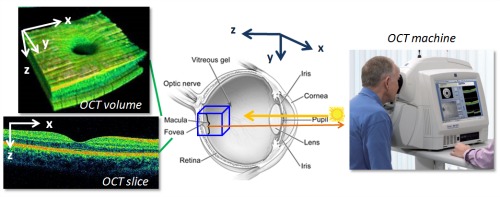
Today, I want to talk about OCT technology, this time applied to cancer research — a segment that was not specifically targeted during the Octoplus camera launch. This topic is particularly meaningful to me, as cancer has affected several loved ones, and I recently attended a webinar by Dr. Laura Selmic, a veterinary surgical oncologist at The Ohio State University.
Dr. Selmic specializes in the surgical treatment of cancer in small animals. Her team explores the use of Optical Coherence Tomography (OCT) and, more recently, Polarization‑Sensitive OCT (PS‑OCT) to evaluate tumour margins in real time during cancer surgery.
OCT is a non‑invasive imaging technique that provides micrometer‑scale, cross‑sectional images of tissue, offering histology‑like detail. In dogs and cats with skin or subcutaneous tumours, her group demonstrated that OCT images correlate well with histopathology and can distinguish normal tissues (skin, adipose, muscle) from sarcoma at surgical margins.
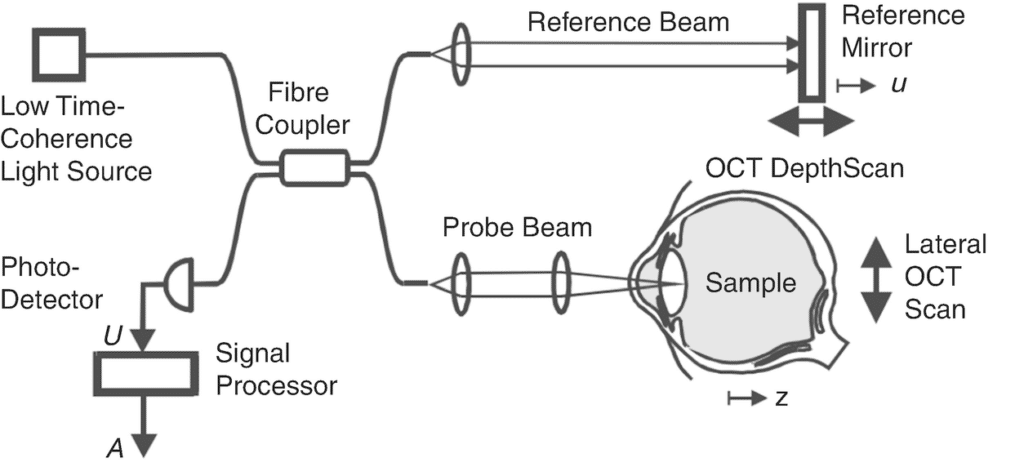
While standard OCT maps tissue based on the intensity of back‑reflected infrared light, PS‑OCT adds another level of contrast by analyzing how tissue alters the polarization state of light. This enhancement provides valuable insights into tissue structure and organization, helping differentiate cancer from collagen‑rich stroma or connective tissue that might otherwise appear similar on standard OCT images.
In a prospective study on dogs with skin and subcutaneous tumours, PS‑OCT images of surgical margins were compared with histopathology to assess whether this technology improved detection of residual cancer. Readers trained in both OCT and PS‑OCT achieved high sensitivity and specificity for identifying cancer at margins. While PS‑OCT did not significantly increase overall diagnostic accuracy, it provided more consistent performance across different levels of reader expertise.
PS‑OCT measures how tissue birefringence — influenced by collagen and muscle fibers — modifies light’s polarization. This allows the generation of additional maps (such as birefringence, retardation, or polarization uniformity) that reveal structural differences invisible in standard intensity images.
In intraoperative cancer imaging, combining OCT and PS‑OCT metrics improves differentiation between normal and cancerous tissue, enhancing the surgeon’s ability to identify clean versus involved margins. Although PS‑OCT adds complexity and requires specific interpretation skills, it shows great promise as a complementary intraoperative imaging tool.
Ultimately, these OCT and PS‑OCT research initiatives aim to develop real‑time imaging systems to guide surgeons — not only in veterinary oncology but, one day, perhaps in human medicine as well — reducing the risk of residual disease and the need for additional treatments.
A promising direction indeed, and one that may further expand OCT’s applications in medical imaging.
References
https://www.teledynevisionsolutions.com/
https://sinogalvo.com/oct-eye-scan-transforming-eye-care/#elementor-toc__heading-anchor-3
https://learnbiomedengine.blogspot.com/2018/05/optical-coherence-tomography-oct.html
https://www.photonics.com/Webinars/Intraoperative_PS-OCT_in_Cancer_Surgery_in_Dogs/w1189
https://octnews.org/