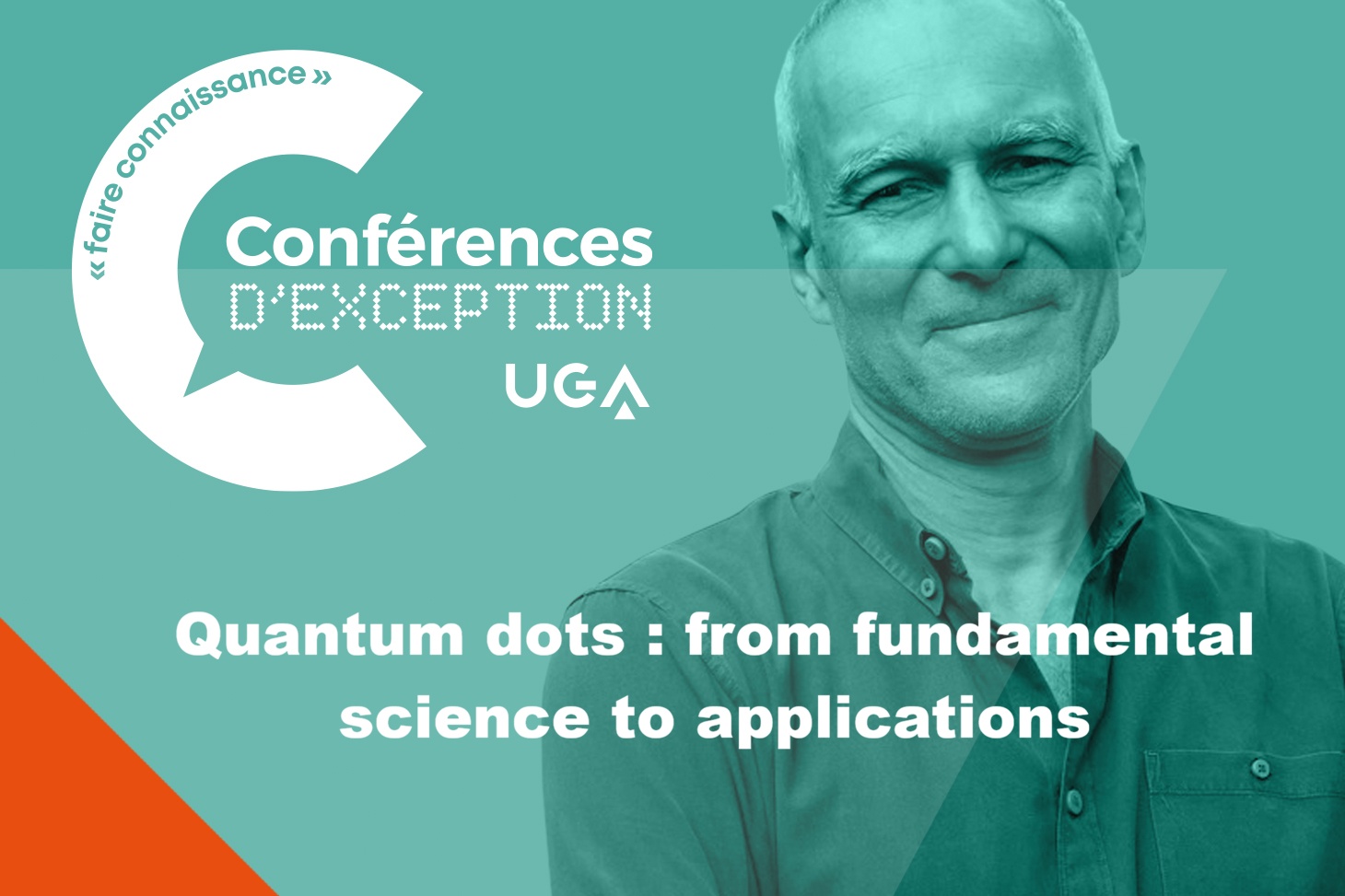
Moungi Bawendi, MIT professor and 2023 Nobel Prize laureate in Chemistry, spoke at Université Grenoble Alpes as part of the “Conférences d’exception: faire connaissance” series. He explained how fundamental research on quantum dots has gradually led to very concrete applications, from displays to healthcare.
What are quantum dots?
A quantum dot is a tiny semiconductor nanocrystal, only a few nanometres in size,made up of hundreds to a few thousand atoms. When exposed to light (for example UV light), it emits fluorescence whose colour depends directly on its size: by changing the size, you can “tune” the emitted colour.
Bawendi stressed that these properties can no longer be explained by classical physics but by quantum confinement effects. At this scale, electrons are “trapped” inside the nanocrystal and their energy levels are quantized, which makes this very fine tuning of optical properties possible.
Bawendi’s decisive advances
The core of his contribution, recognised by the Nobel Prize, lies in mastering the colloidal synthesis of high‑quality quantum dots. In the early 1990s at MIT, his group developed the so‑called “hot injection” method, which allows very precise control of nanocrystal size and produces highly uniform particle populations.
This control results in sharp absorption bands and intense, tunable luminescence, indicating excellent crystalline quality and very few defects. This qualitative leap opened the way to industrial devices that truly use quantum dots and led him to share the Nobel Prize with Louis Brus and Alexey Ekimov.
Applications already here… and those to come
During the lecture, Bawendi illustrated how these nanocrystals are already part of our daily lives. They are used in brighter, more colourful LED and QLED displays, but also in high‑precision biomedical imaging techniques where different quantum dots serve as fluorescent labels.
He also mentioned their potential to improve solar cell efficiency and to contribute to some building blocks of emerging quantum technologies. In his view, despite the progress and widespread uses, “there is still an enormous amount of exciting work to be done” on these materials.
Embedded in Grenoble’s strong ecosystem in quantum science and technology, the lecture linked a major scientific journey with local innovation challenges. Bawendi showed how curiosity for nanometre‑scale objects, which at first seem very fundamental, can lead to major industrial applications, echoing the ambitions of UGA and its partners in the quantum field.
The complete conference is here : Moungi Bawendi conference on YouTube